Corporate Skateboard Team Building in NYC & Westchester
Why your team will remember a skateboard session long after they’ve forgotten the escape room—and what it actually looks like when 15 adults in sneakers try to push across a parking lot.
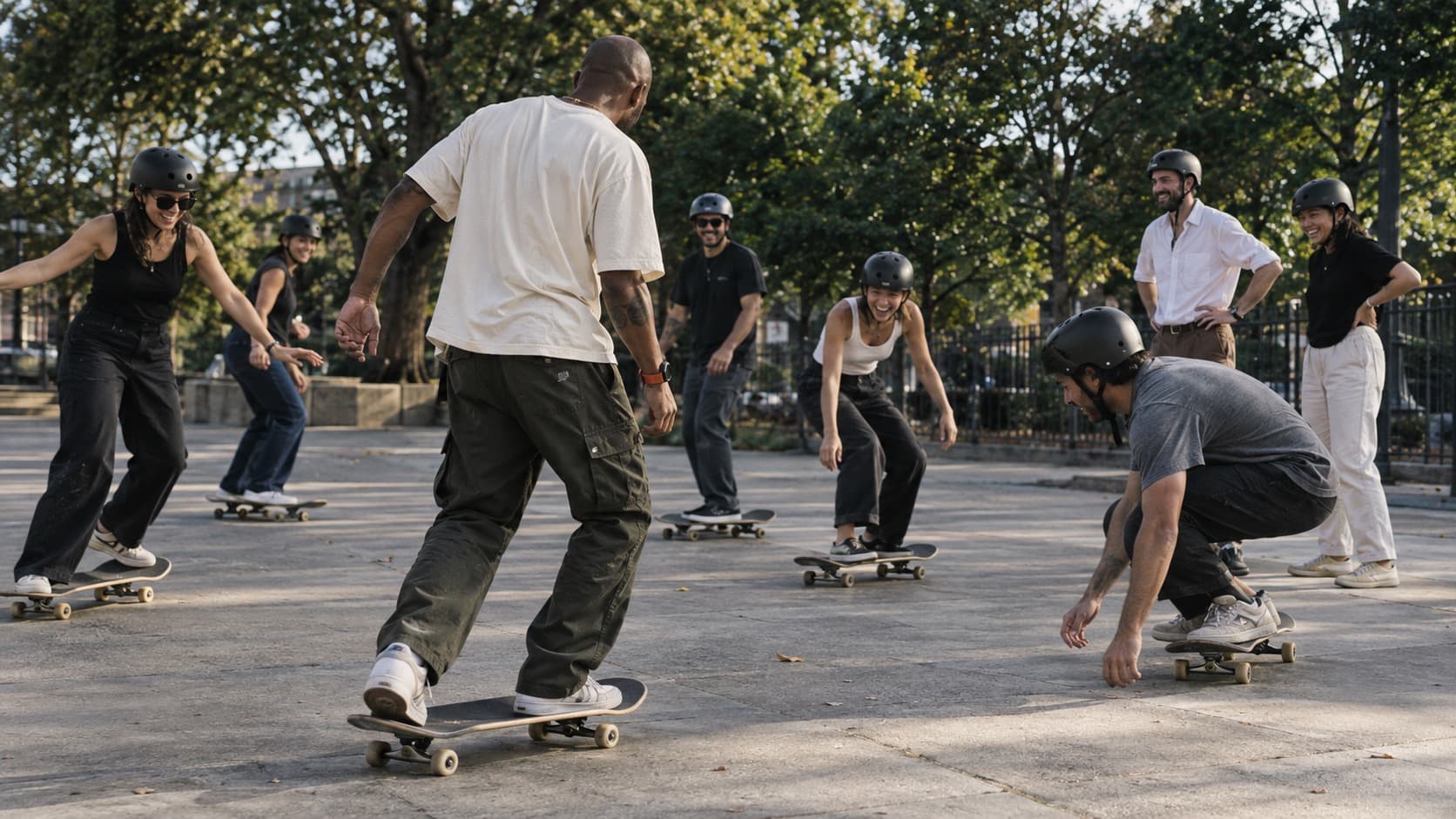
Most team building is forgettable. You know the drill: trivia night, bowling, an escape room where one person solves it and everyone else watches. You go back to the office the next day and nothing is different. Nobody learned anything about each other that they didn’t already know.
Skateboarding is different because it puts everyone in the same place—genuinely, not artificially. When your VP and your newest hire are both standing on a board for the first time, trying not to fall, there’s no rank. No one has an advantage. The playing field isn’t leveled—it was never there to begin with.
Leon Toppin has been teaching skateboarding for over 20 years in NYC and Westchester. He’s taught kids, adults, families, and corporate groups. The corporate sessions came about because people kept asking for them—teams that wanted something their employees would actually talk about afterward.
Why skateboarding works for teams
The first thing that happens when a group of adults gets on skateboards is that the hierarchy disappears. It doesn’t matter who runs the department or who just started last month. Everyone is a beginner, and everyone looks exactly like one. That’s not something you can manufacture with an icebreaker.
Skateboarding is genuinely hard. Not pretend-hard like a ropes course, where the difficulty is mostly psychological. You have to learn to balance on a moving object, coordinate your feet, and push without toppling over. Everyone struggles with it. Everyone wobbles. And because everyone is struggling at the same time, the usual social armor comes off. People laugh at themselves. They cheer for each other. They ask for help without thinking about it.
That shared vulnerability is the whole point. When your team watches their manager eat it on a push and get right back on the board, that does more for trust than any offsite presentation. It’s not a metaphor about falling and getting back up—it’s the real thing, happening in real time, in front of people they work with every day.
The other thing that makes it work: skateboarding is individual but not isolating. Everyone is working on the same challenge, but each person progresses at their own pace. There’s no one getting left behind and no one running ahead. The group energy builds naturally because every person’s small win feels like a group win.
What a corporate session looks like
Sessions run 1.5 to 3 hours depending on the package and what the group wants out of it. Here’s how a typical session breaks down:
- Arrival and gear up(10–15 minutes)—Leon meets the group, hands out boards, helmets, knee pads, elbow pads, and wrist guards. He covers how to fall safely before anyone steps on a board. This part matters more than people think.
- Stance and balance(15–20 minutes)—everyone finds their natural stance (regular or goofy), learns to stand on the board, and gets comfortable shifting weight. This is where most of the wobbling happens.
- Pushing and riding(20–30 minutes)—the core skill. Pushing across flat ground, staying balanced, learning to stop. By the end of this block, most people can ride a short distance on their own.
- Mini challenges(20–30 minutes)—depending on how the group is doing, Leon introduces small goals: ride from point A to B, weave through cones, try a kick turn. Not competitive—just something to aim for.
- Group moment(10–15 minutes)—free skate time where the group can practice, try things on their own, and skate with each other. This is usually when the best photos happen and people realize they’re actually having fun.
The pacing is flexible. Some groups pick it up fast and want more challenge. Some groups are perfectly happy spending the whole session just learning to ride. Leon reads the room and adjusts. That’s what 20 years of teaching does—he knows when to push and when to let people find their own rhythm.
What makes it different from other team building
Most team building activities fall into a few categories: competitive (someone wins, someone doesn’t), instructional (follow this recipe, solve this puzzle), or passive (watch, listen, observe). Skateboarding is none of those.
There’s no winner. Escape rooms have a winner—the person who figured out the lock while everyone else stood around. Cooking classes follow a recipe—you’re executing someone else’s instructions. Trivia rewards the person with the most random knowledge. All of those have a built-in hierarchy, even if it’s unofficial.
Skateboarding doesn’t have a right answer. There’s no recipe to follow. You can’t coast on being the smartest person in the room. It’s just you and the board, and the board doesn’t care about your job title. That kind of equalizer is hard to find in a city full of corporate event options.
And the struggle is real. Nobody is faking difficulty for the sake of a bonding exercise. Learning to push on a skateboard is actually challenging, and the fact that everyone is genuinely working through it together creates something that’s hard to replicate with activities designed to feel hard but aren’t really.
Book a team session
Tell Leon about your group. He'll put together a format, pick a location, and confirm availability.
Logistics
Group size
Sessions work best with 5 to 20 people. For groups larger than 20, Leon runs rotating sessions—half the group skates while the other half watches, then they switch. This keeps everyone safe and makes sure each person gets real instruction time, not just a board and a wave goodbye.
Location
Leon picks the location based on the group size, skill level, and area. Smooth outdoor spaces, parking lots, skate parks, and paved plazas all work. He teaches across NYC and Westchester County and knows which spots work best for corporate groups—flat, open, and away from traffic.
Equipment
Leon brings everything—skateboards, helmets, knee pads, elbow pads, and wrist guards. Your team doesn’t need to buy, borrow, or bring any gear. Just show up in sneakers.
What to wear
Flat-soled sneakers and comfortable clothes. No heels, no sandals, no dress shoes. Jeans are fine. Athletic wear is fine. Anything you can bend your knees in works. This is not a suit-and-tie event.
Weather
Outdoor sessions need dry pavement. If it rains, the session gets rescheduled—no one loses their booking. For cold weather or groups that want a guaranteed indoor option, Leon has access to covered and indoor spaces. Just let him know when you book.
Who books this
The short answer: anyone who’s tired of the same team outing options and wants their group to do something they’ll actually remember.
Tech companies that want to get their team away from screens. Creative agencies that want something that matches their energy. Startups that want a bonding experience without the corporate-retreat feel. Nonprofits running staff appreciation days. School faculty looking for something fun during a professional development break. HR managers planning a summer outing that isn’t another happy hour.
The common thread is simple: groups that want their people to try something new together, laugh together, struggle a little, and walk away with a story. Not a group activity that checks a box—an experience people bring up at lunch the next week.
How to get started
Email Leon or call him at (914) 294-4407. Tell him your group size, a few preferred dates, and anything he should know about the group (first-timers, mixed experience, any accessibility needs). He’ll put together a plan—format, location, timing, and pricing.
For more on how Leon works with corporate groups, visit the corporate page. You can also see all of Leon’s programs for organizations. To check availability or book directly, head to the booking page.
Frequently Asked Questions
How large can a corporate group be for a skateboard team building session?+
Groups of 5 to 20 work best. For groups larger than 20, Leon runs rotating sessions so everyone gets hands-on time on a board. He'll work with you on a format that fits your headcount.
Does everyone need skateboarding experience?+
No. Most corporate groups are complete beginners, and the session is built for that. Leon teaches from the ground up — stance, balance, pushing — so nobody is expected to know anything going in.
What should people wear to a corporate skateboard session?+
Flat-soled sneakers and comfortable clothes they can move in. No heels, sandals, or dress shoes. Leon provides all equipment — skateboards, helmets, knee pads, elbow pads, and wrist guards.
Are indoor options available for bad weather or winter?+
Yes. Leon has access to indoor spaces and can arrange covered locations for cold weather or rain. If an outdoor session gets rained out, it gets rescheduled — no one loses their booking.
Ready to book a team session?
20+ years of instruction. All equipment provided. NYC and Westchester County.