October 9, 2026
The best skateboard gifts for kids: a holiday guide from someone who teaches this every day
What to buy, what to skip, and what a kid who skates actually wants to unwrap.
Every November, I start getting the same phone call. A parent, grandparent, or uncle is shopping for a kid who either skateboards or wants to start, and they have no idea what to buy. They’re staring at Amazon listings, overwhelmed by options that all look the same, and they’re worried about picking the wrong thing.
I’ve been skating for over 30 years and teaching for 20. I’ve seen kids light up over a new deck and I’ve seen them struggle with a board that was never going to work for them. The difference usually comes down to a few decisions that are easy to get right once someone tells you what to look for. So here it is—an honest gift guide from someone who does this every day.
A complete skateboard (the big gift)
If the kid doesn’t have a board yet, this is the one. A “complete” means the deck, trucks, wheels, bearings, and grip tape all come assembled and ready to ride. It’s the skateboard equivalent of a bike with training wheels already on.
The brands I recommend to my students’ families are Enjoi, Krooked, Baker, Element, and Santa Cruz. These companies make completes in the $80 to $130 range that use real components—decent trucks, bearings that actually roll, and a deck that won’t snap in a month. For younger kids (under 10), look for a 7.5-inch width. For tweens and teens, 7.75 to 8.0 inches is usually right. Bigger teens or anyone who wants more stability should go up to 8.25.
One thing I tell every parent: avoid the boards you find at Walmart, Target, or generic Amazon listings. I know they’re cheaper—usually $25 to $40—but the trucks are stiff plastic, the bearings seize up fast, and the deck itself is heavy and poorly shaped. A kid trying to learn on one of those boards is fighting the equipment instead of learning. It’s like trying to teach someone to cook with dull knives. Spend a little more and get them something that works.
Your local skate shop is the best place to buy a complete. Staff will help you pick the right size, and you’re supporting the skate community at the same time. If there isn’t a shop near you, CCS.com and Tactics.com are reliable online options with good selection.
Protective gear (the gift they need)
Not the most exciting thing to unwrap, but some of the most important gear a skater can own. I bring helmets and pads to every lesson I teach, and I won’t start a session without them for beginners.
A certified helmet is non-negotiable. Look for CPSC or ASTM certification—it’ll say so on the box or inside the helmet. Triple 8 and Pro-Tec are the industry standards. The Triple 8 Sweatsaver ($40 to $50) is what I see most often at parks. Pro-Tec’s Classic Certified ($50 to $60) is another solid pick. Both come in enough colors and styles that a kid will actually want to wear them.
For knee pads and elbow pads, the same two brands lead. A full pad set (knees, elbows, and wrist guards) from Triple 8 runs about $30 to $50. If you’re buying for a younger kid who’s just starting, get the pads. They’ll fall more in the beginning, and comfortable pads mean they’re less afraid to try again.
Skate shoes (the gift they’ll wear every day)
Skate shoes are built differently from regular sneakers. The soles are flat for better board feel, the materials in the ollie area are reinforced so they don’t rip apart in a week, and the cushioning is designed for impact. A kid skating in running shoes is going to have a harder time and burn through those shoes fast.
Vans is the classic. The Old Skool and Sk8-Hi are both genuinely good skate shoes, and they run $60 to $75 for kids and $70 to $85 for adults. Nike SB has solid options in the $75 to $100 range that teens tend to gravitate toward. For durability, look at the Vans Skate line (different from their lifestyle line—reinforced construction) or Nike SB Chron or Janoski. Lakai, Emerica, and ÉS are all skater-owned brands that make great shoes, usually in the $65 to $85 range.
If you’re not sure about size or style, a gift card to a skate shop lets the kid pick their own. Most skaters are particular about their shoes, especially teenagers.
Know a kid who wants to learn?
Book a private skateboard lesson with Leon. NYC, Westchester, and parts of CT. All ages, all levels. Gear provided.
Skateboard accessories (stocking stuffers that are actually useful)
If the kid already has a board, accessories are a great move. Skateboarders are always wearing things down and replacing parts, so these gifts get used instead of collecting dust.
Bearings are probably the most universally appreciated upgrade. Bones Reds ($18 to $22 for a set of 8) are the gold standard at the affordable end. They make an old board feel new again. If you want to spend a little more, Bones Swiss ($50 to $60) are smoother and last longer.
Wheels are another solid pick. Spitfire Formula Four and Bones STF are what most skaters ride. A set of four runs $30 to $40. If you don’t know what size to get, 52mm to 54mm with 99a hardness covers most street and park skating.
Grip tape ($5 to $12) comes in different colors and graphics now, and re-gripping a board is something kids enjoy doing themselves. Mob and Jessup are the standard brands. A skate tool ($10 to $15) is one of those things every skater needs but never buys for themselves—it tightens and loosens every bolt on the board. And a good water bottle is never a bad idea. Skating is more physical than people think.
Skateboard lessons (the gift that gets them started right)
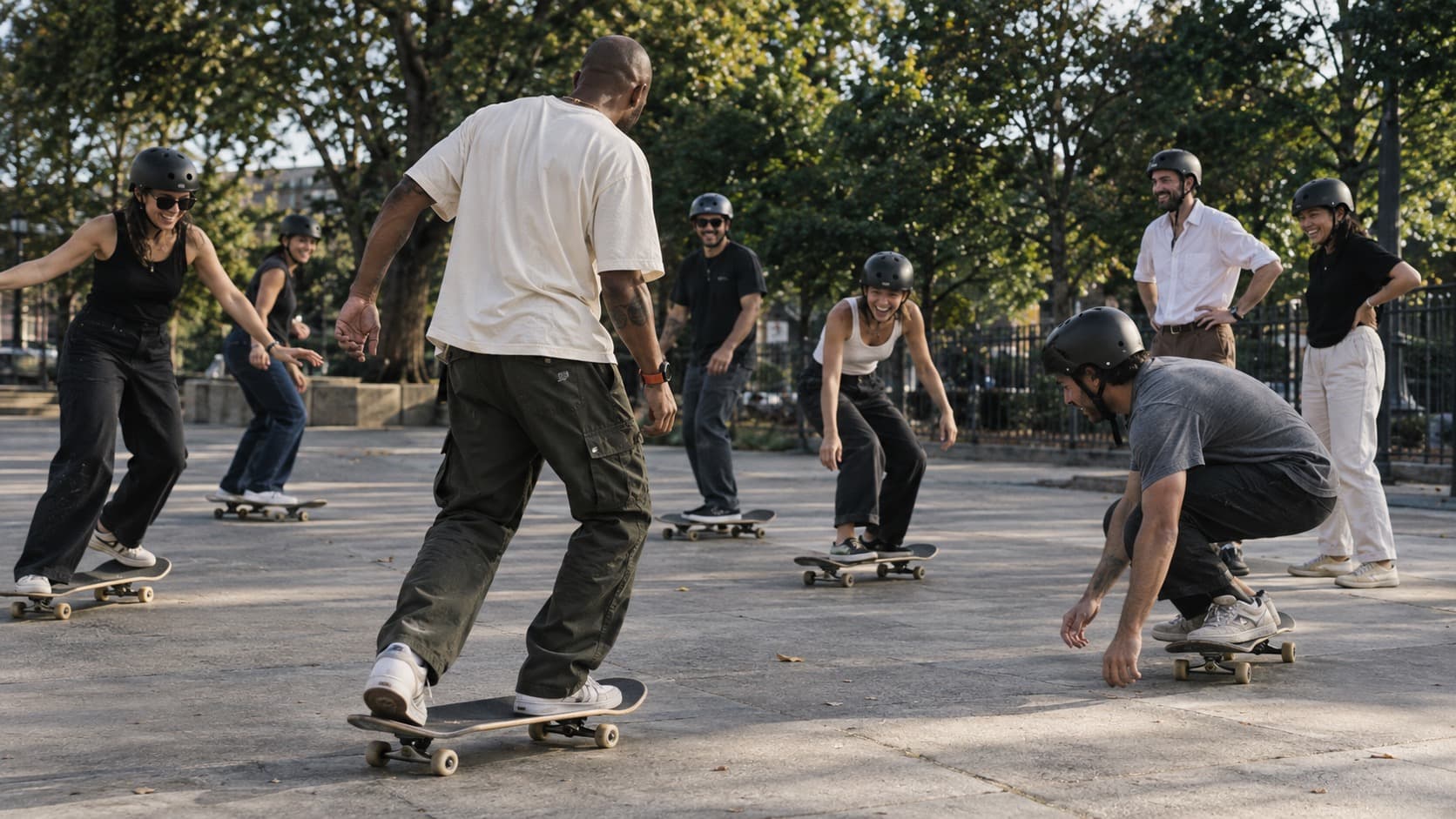
I’m biased here, but I sell more gift cards in November and December than any other time of year, and the feedback from families is consistent: kids who start with instruction progress faster and get injured less. A lesson takes the guesswork out of the first few sessions and gives them real skills to build on.
A single private lesson is $120per hour, and I bring boards, helmets, and pads to every session, so the recipient doesn’t need to own any gear. If you want something more substantial, the three-lesson starter pack is $300—that’s enough time for a beginner to get comfortable pushing, turning, and stopping on their own.
I teach ages 3 through adult, across NYC, Westchester, and parts of Connecticut. Gift cards don’t expire and the recipient books at their own convenience. If you want to read more about what a first lesson looks like, I wrote about that here.
Give them the real thing
A skateboard lesson gift card starts at $120. Three-lesson starter packs are $300. Ages 3 through adult.
Browse Gift CardsSkate apparel and soft goods
Skateboard brands make clothes, and most skaters care about what they wear. This is where personal taste matters, so if you’re buying for a teenager, pay attention to the brands on the boards and shoes they already ride.
Thrasher, HUF, Independent, and Santa Cruz all make tees and hoodies in the $30 to $70 range. Dickies work pants are a staple in skating—tough, cheap ($25 to $35), and they hold up to concrete. Socks might sound boring but brands like Stance make skate-specific socks with extra cushioning in the heel and toe ($12 to $18). A beanie from any skate brand is always a safe pick for winter, usually around $20 to $30.
The easiest way to nail this category is to walk into a local skate shop and ask the staff. They see what kids are buying every day and they’ll point you in the right direction based on age and budget.
Books, videos, and media
Skating has a rich culture and history, and there are some great gifts in this space that go beyond the physical gear. For younger kids, “Skateboarding Is Not a Crime: 50 Years of Street Culture” by James Davis is a solid coffee table book with great photos. Tony Hawk’s autobiography is a good read for teens who are into the competitive side. “The Mutt: How to Skateboard and Not Kill Yourself” by Rodney Mullen is honest and funny and appeals to kids who like the more creative, street-skating side of things.
If the kid is more into watching, a subscription to Thrasher Magazine ($20/year) gives them a monthly dose of skate culture. For video, “Mid90s” by Jonah Hill is a good movie about skate culture (rated R, so for older teens), and the documentary “All This Mayhem” about the Pappas brothers is gripping and real.
What to avoid
I mentioned this above but it bears repeating: stay away from cheap boards at big-box stores. If a “complete skateboard” costs $25, there’s a reason. The components are poor quality, and the experience of riding one is frustrating enough to make a kid think they don’t like skating when the truth is they just had a bad board.
Also avoid buying a board that’s too big. A full-size 8.25-inch deck for a small 6-year-old is going to be heavy and awkward. It’s like handing a kid an adult tennis racket—they can hold it, but they can’t do anything with it. Size the deck to the skater.
And if you’re unsure about any of it, just ask. Ask the kid, ask a skate shop employee, or ask their instructor. We’d all rather help you pick the right thing than see a kid end up with gear that doesn’t fit.
Quick reference by budget
Under $25: grip tape, a skate tool, skate socks, or stickers from a local shop. These are small but thoughtful, and every skater uses them.
$25 to $50: Bones Reds bearings, a set of wheels, a beanie, a skate book, or a pad set. Functional gifts that upgrade what they already have.
$50 to $100: a certified helmet, skate shoes, or a single lesson gift card. These are the gifts that make a real difference in how a kid skates.
Over $100: a quality complete skateboard or a lesson starter pack ($300 for three sessions). The kind of gift that kicks off a whole new thing.
Whatever you pick, the fact that you’re thinking about it this carefully means you’re going to get it right. The best gift for a kid who skates is one that shows you took their interest seriously.
Give the gift of a lesson
Private lessons start at $120/hr. Gift cards available for any amount. Leon brings all the gear — ages 3 through adult.
Frequently asked questions
Still not sure what to get?
Call or text me and tell me about the kid. Age, experience level, what they’re into. I’ll tell you exactly what to buy.