Why Schools Are Adding Skateboarding to Their Enrichment Programs
Skateboarding is showing up in school enrichment programs across NYC and Westchester. Here’s what that looks like, and why it works.
How did you get into running skateboard programs at schools?
A principal in the Bronx reached out about five years ago looking for something beyond the usual team sports. I’d been teaching private skateboard lessons for over 15 years, so I built a program from scratch. That first semester proved what I suspected—skateboarding reaches students that traditional PE enrichment misses.
About five years ago, a principal at a school in the Bronx called me. She said they were looking for enrichment activities that weren’t the usual suspects. No more basketball clinics, no more soccer. She asked if I’d ever taught skateboarding to a group of kids in a school setting. I hadn’t. But I’d been teaching private lessons for over 15 years by that point, and I figured I could build something that worked.
That first program was rough around the edges. I brought 15 boards, a bag of helmets, and a loose plan. By the second week, I had a much better understanding of what works in a school setting and what doesn’t. By the fourth week, those kids were riding across the schoolyard on their own, and the principal was asking me to come back next semester.
Since then, I’ve run school skateboard programs across NYC and Westchester. The format has gotten tighter, the curriculum has gotten better, and the response from students, teachers, and parents keeps confirming what I suspected from day one: skateboarding fills a gap that most PE enrichment activities miss.
Why does skateboarding work as a school enrichment activity?
Skateboarding reaches students that team sports don’t. According to the Aspen Institute’s 2024 State of Play report, only about 33% of children ages 6–12 regularly play team sports. Skateboarding gives every kid their own board and their own pace—no bench, no tryouts, no waiting for a turn.
Most PE enrichment activities are built around team sports. That’s fine for the kids who already like sports. But there are always students who hang back during basketball or stand at the edge of the field during soccer. They’re not lazy or disinterested. The format just doesn’t reach them.
Skateboarding is different. There is no bench. There are no tryouts. Every kid gets a board, and every kid participates from minute one. Progress is individual. The kid who’s struggling with balance isn’t holding anyone back, and the kid who picks it up fast isn’t waiting for everyone else. They’re all working at their own pace, on their own board. That structure works for kids who don’t connect with team sports, and it keeps the athletic kids engaged too.
There’s also the novelty factor. These kids have played kickball. They’ve done relay races. Skateboarding feels genuinely new to most of them, and that makes the energy in the session completely different. They’re excited. They want to be there. You can’t buy that kind of engagement.
What does a school skateboard program look like week to week?
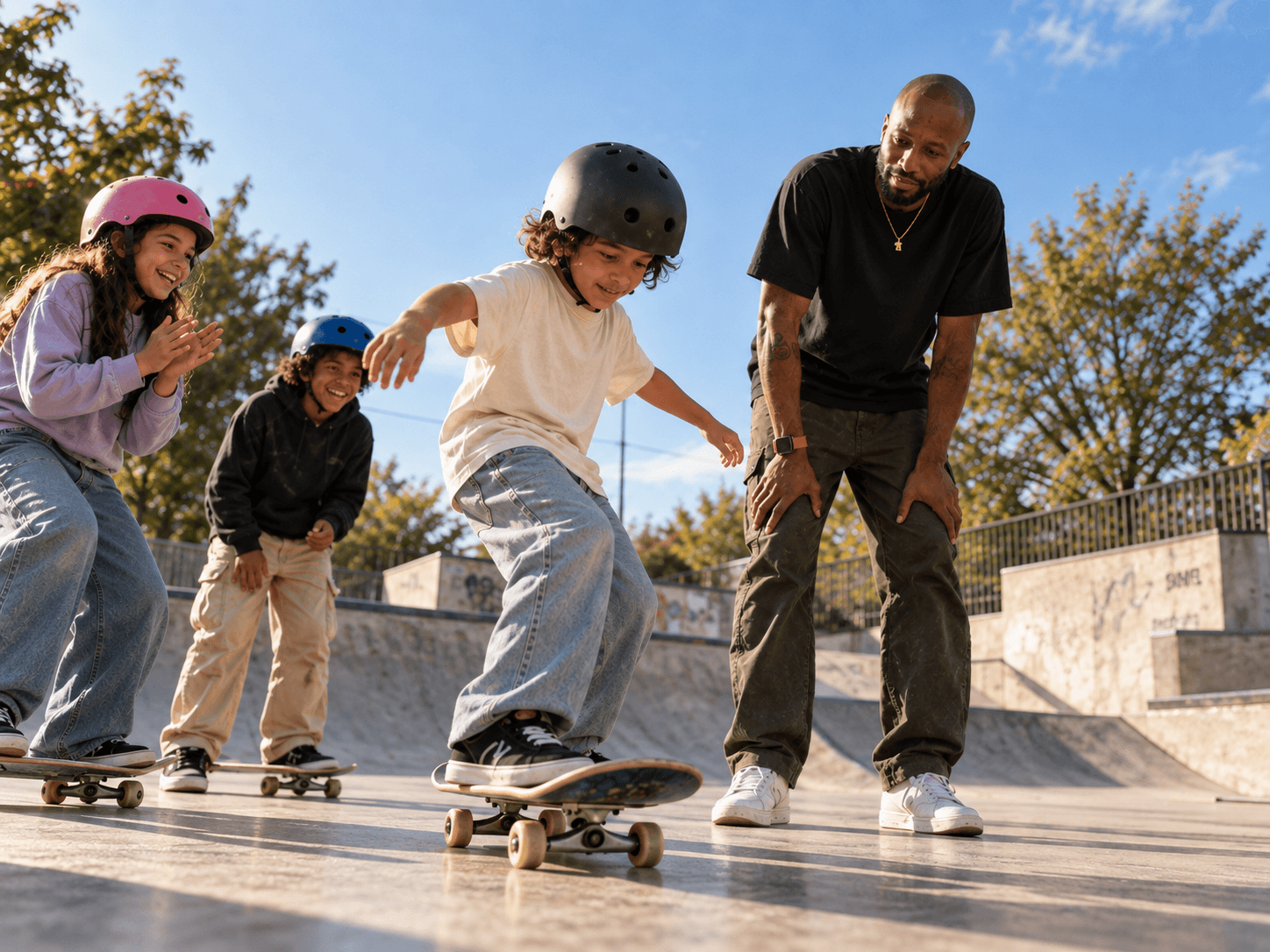
A typical program runs four to eight weeks with one or two sessions per week. I bring all equipment—boards, helmets, pads. Week one covers safety and falling technique before anyone rides. From there, students progress through pushing, turning, stopping, and basic tricks, building each week on what they learned before.
A typical program runs four to eight weeks, one or two sessions per week. I bring all the equipment: boards, helmets, knee pads, elbow pads. The school doesn’t need to buy anything. Students just need closed-toe shoes and clothes they can move in.
Week one is all about safety and getting comfortable. I teach falling before I teach riding. Kids learn how to step on the board, how to balance, and how to bail safely. We cover foot placement, stance (regular vs. goofy), and basic pushing. By the end of the first session, most students can push and glide on flat ground.
From there, the curriculum builds week by week. Turning, stopping, riding over small obstacles, basic tricks. Each session has a structure: warm-up, skill introduction, practice time, and a session wrap where students show each other what they learned. That last part matters. Kids love showing what they figured out, and it builds a community feeling in the group.
Groups are capped at 20 students to keep the ratio tight. For larger groups, I bring assistant instructors. A gym, schoolyard, parking lot, or any flat smooth surface works. I’ve set up in all of those.
Want to try it yourself?
Book a private lesson with Leon. NYC and Westchester, all ages and skill levels.
What benefits does skateboarding give students beyond physical exercise?
The biggest feedback I get from teachers is about confidence and behavior, not fitness. A 2023 study in the International Journal of Environmental Research and Public Health found that action sports like skateboarding significantly improve self-efficacy in youth participants. I see it play out every program—quiet kids start speaking up, restless kids find focus.
Yes, skateboarding is a workout. It builds core strength, balance, and coordination. But the benefits that schools keep telling me about have more to do with confidence and behavior than fitness.
Teachers notice that students carry themselves differently after a few weeks in the program. Kids who were quiet and withdrawn start talking about what they’re working on. Kids who were disruptive in class channel that energy into something productive. Learning to skateboard is hard, and sticking with it teaches persistence in a way that a worksheet about growth mindset never will.
I’ve seen this especially with students who have ADHD. Skateboarding gives them the constant physical feedback and immediate results that their brains need to stay engaged. I wrote more about that connection here, but in a school setting, it plays out clearly. The kids who can’t sit still in class are often the ones who take to skateboarding the fastest.
There’s also the social piece. Skateboarding has its own culture of encouragement. At a skatepark, when someone lands a trick, everybody cheers. That culture transfers into the school program. Kids start hyping each other up. The competitive edge that makes some sports stressful gets replaced by something more supportive. I watch it happen every time.
How does skateboarding being in the Olympics affect school programs?
Skateboarding returns to the Olympics in 2028 in Los Angeles, and that legitimacy matters for schools. The 2024 Paris Olympics drew over 26 million viewers for skateboarding events alone. When a principal needs to justify the program to a school board or PTA, the Olympic connection makes that conversation significantly easier.
Skateboarding is in the 2028 LA Olympics. That matters for schools, because it gives administrators an easy way to frame the program. This isn’t a fringe activity anymore. It’s an Olympic sport with structured competition, recognized athletes, and growing infrastructure. When a principal needs to justify the program to a school board or a PTA, the Olympic status helps.
It also matters for the kids. They see skateboarding on TV, they see athletes competing at the highest level, and suddenly the thing they’re learning in the schoolyard has a bigger context. That connection to something real and visible gives the program extra weight.
How can a school get started with a skateboard program?
Reach out and I’ll walk you through the options. I run programs across NYC and Westchester County, and every program is built around the school’s schedule, space, and student population. If you’re a parent who wants this at your kid’s school, bring it up with the PE department or enrichment coordinator—that’s how most of my school partnerships start.
If you’re an administrator, PE teacher, or after-school coordinator looking into enrichment options, I’d be happy to talk about what a program could look like at your school. I run programs in NYC and Westchester County, and every program is built around the school’s schedule, space, and student population. You can learn more on my school programs page.
If you’re a parent and you want your kid’s school to offer this, bring it up. Talk to the PE department, the enrichment coordinator, or whoever handles programming. My parent’s guide covers a lot of the questions families have about kids and skateboarding, and most of it applies to the school setting too. Schools that offer this kind of program are giving their students something they want to show up for. That’s worth a conversation.
Frequently asked questions
What does a school skateboarding program include?+
A typical school skateboarding program runs 4 to 8 weeks and includes all equipment (skateboards, helmets, pads), a structured curriculum, and trained instructors. Students learn safety, balance, pushing, turning, and basic tricks in a progression that builds each week.
Is skateboarding safe for schools?+
Yes, with proper instruction and equipment. Every student wears a helmet. Falling technique is taught before riding technique, and sessions start with a safety review. Leon has run school programs for years with an excellent safety record.
What grades are school skateboard programs designed for?+
Programs work for kindergarten through 12th grade. The curriculum adjusts for age and ability. Most school programs serve elementary and middle school students, but high school programs work well too.
Does the school need to own skateboards or equipment?+
No. The instructor brings everything: skateboards, helmets, pads, and any other safety gear needed. Students just need closed-toe shoes and clothes they can move in.
Bring skateboarding to your school
Leon runs structured skateboard programs for schools across NYC and Westchester. Equipment, instruction, and curriculum included.
Learn About School Programs