September 8, 2026
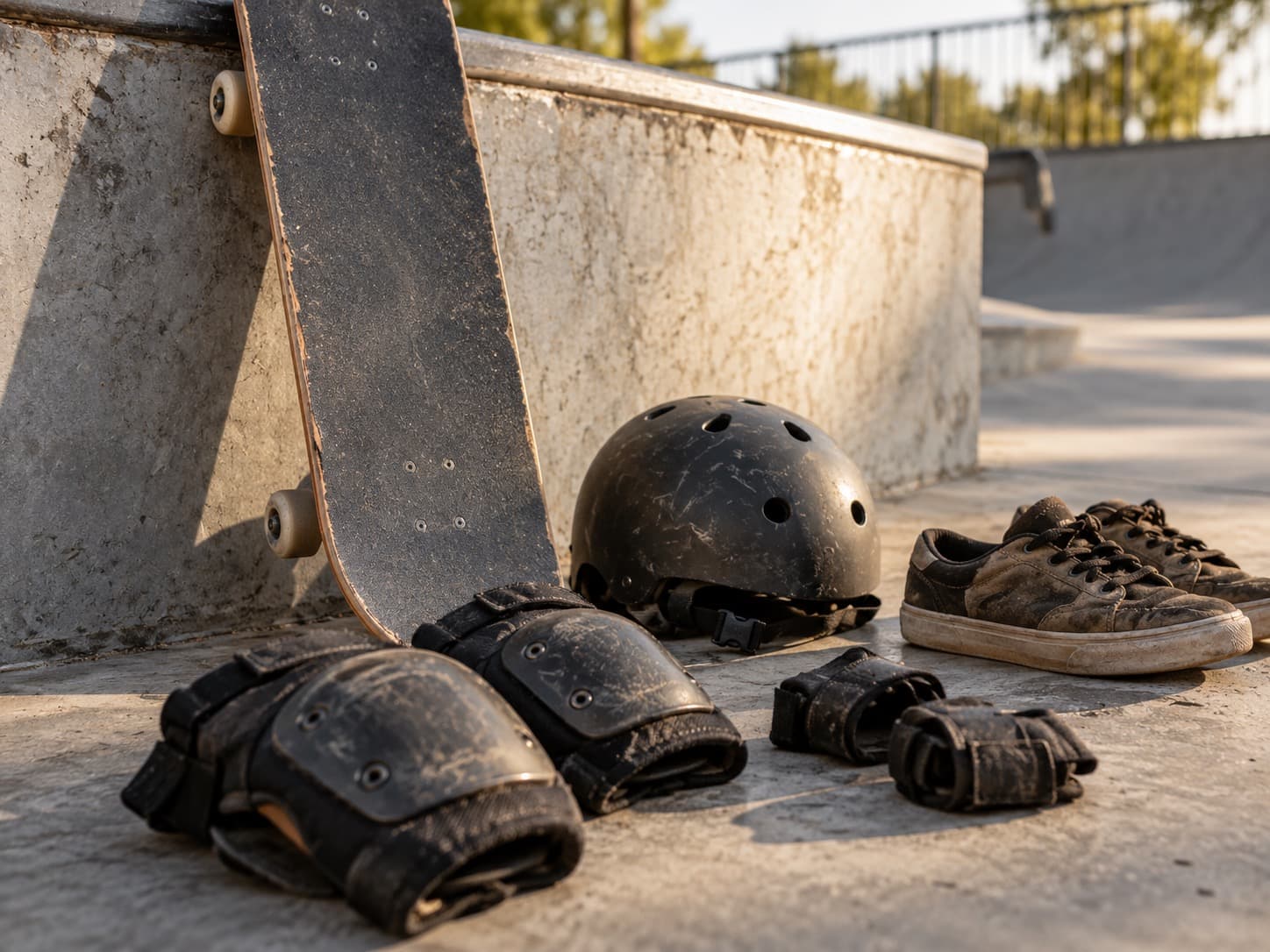
What protective gear does your kid need for skateboarding?
A gear guide from someone who has caught more falling kids than he can count.
Parents ask me about gear more than they ask me about the actual skateboard. I understand why. Your kid is about to stand on a board with wheels on concrete, and your brain immediately goes to worst-case scenarios. Fair enough. (If your bigger question is whether skateboarding is safe for kids in the first place, I covered that separately.)
But most of the information out there is written by gear companies trying to sell you a full set. After 20 years of teaching kids to skate, here is what I tell parents to buy and what they can skip. (For the bigger picture beyond gear, start with my parent’s guide to kids’ skateboard lessons.)
1. Do kids need a helmet for skateboarding?
Yes—every single time. Head injuries account for roughly half of all skateboarding-related ER visits for children under 14. A CPSC-certified skate helmet is the one piece of gear I will never let a student skip, and most skateparks enforce the same rule.
I require helmets for every student under 18. This is not negotiable, and most skateparks have the same rule. But the type of helmet matters.
Get a CPSC-certified skate helmet, not a bike helmet. Skate helmets cover more of the back of the head, which is where most skateboard falls land. Bike helmets are designed for a different kind of impact (forward, over the handlebars) and leave the back of the skull exposed.
The brands I see most often on my students: Triple Eight, Pro-Tec, and S1. They run $30–$60. A $35 Triple Eight Sweatsaver is perfectly good. Do not buy the cheapest helmet you can find on Amazon because the fit will be wrong and your kid will hate wearing it, which means they’ll fight you on it every time.
Fit is everything. The helmet should sit level on the head, not tilted back like a baseball cap. The front edge should be about two finger-widths above the eyebrows. If it wobbles when they shake their head, it’s too big. Most helmets come with different thickness pads inside so you can dial in the fit.
2. Should kids wear wrist guards for skateboarding?
I recommend wrist guards for every beginner, kid or adult. Wrist fractures and sprains are the most common skateboarding injury in children—the instinct to catch yourself with outstretched hands is almost impossible to override at the start. A $15–$25 pair with a rigid splint changes the math completely.
When a beginner falls, the very first thing they do is put their hands out. Every single time. It’s an instinct you cannot train away quickly, especially in kids. And catching yourself on outstretched palms on concrete is how wrists get sprained.
Wrist guards have a rigid plastic splint that distributes the impact across the whole forearm instead of concentrating it on the wrist joint. I recommend them for every beginner, adult or child. If you’re only going to buy one piece of protective gear besides the helmet, make it wrist guards.
A decent pair costs $15–$25. Make sure they fit snugly and don’t slide around. Loose wrist guards are almost as bad as no wrist guards because the splint shifts on impact and does nothing useful.
3. Do kids need knee pads for skateboarding?
It depends on where they’re skating. At a skatepark, yes—knee pads are required at most parks and they double as a bail technique (the knee slide). On flat ground, they’re more about confidence than injury prevention, since most beginner falls go sideways, not straight onto the knees.
Knee pads are mandatory at most skateparks, and for good reason. When you’re skating a ramp or bowl, knee slides are a controlled way to bail. Experienced skaters drop to their knee pads on purpose when things go wrong. It’s a safety technique, and a good pair of pads makes it painless.
For flat ground lessons, knee pads are less critical. Most beginner falls on flat ground go sideways or backwards, not straight down onto the knees. That said, some kids feel more confident with them on, and confidence is half the battle when you’re learning. If wearing knee pads helps your child commit to trying something new, they’re worth it for that reason alone.
For knee pads, you want the hard-cap style (like 187 Killer Pads or Triple Eight), not the soft sleeve kind that volleyball players wear. The hard cap lets you slide on the surface instead of catching and tumbling. A set of good ones runs $30–$50.
Want to try it yourself?
Book a private lesson with Leon. NYC and Westchester, all ages and skill levels.
4. Are elbow pads necessary for skateboarding?
Not really, especially for beginners on flat ground. Elbow injuries make up a small fraction of skateboarding injuries compared to wrists and knees. Most of my students ditch elbow pads after a few sessions because they slide down the arm and become more distracting than protective.
Most of my students stop wearing elbow pads after a few sessions, and I don’t push back on it. Elbow injuries from skateboarding are far less common than wrist and knee injuries, especially at the beginner level.
Elbow pads also tend to slide down the arm constantly, which distracts kids. They spend more time adjusting their pads than skating. If you buy a three-pack that includes elbow pads (many sets bundle knee pads, elbow pads, and wrist guards together), use them. But I would not buy elbow pads separately if you’re on a budget.
5. What shoes should kids wear for skateboarding?
Any flat-soled sneaker—Vans, Converse, Adidas Superstars, Nike SB. The sole should look flat from the side with no raised heel or curved arch. Running shoes make the board unstable, and sandals are genuinely dangerous. Shoes are protective gear most parents overlook.
Shoes are protective gear. Flat-soled shoes with a wide toe box give your kid board feel and grip. Running shoes with a curved sole make the board feel unstable. Sandals and flip-flops are genuinely dangerous.
You do not need to buy skate shoes specifically. Any flat-soled sneaker works. Vans, Converse, Adidas Superstars, Nike SB. The sole should be flat when you look at it from the side. If the heel is raised or the sole has a big curve to it, it’s the wrong shoe for skating. I wrote a full guide to skate shoes if you want the details.
One more thing: skateboarding destroys shoes. The grip tape on top of the board is basically sandpaper. Do not let your kid skate in their brand new back-to-school shoes. Dedicate an older pair to skating and save yourself the argument.
6. What skateboard gear should I buy for my kid?
Start with a CPSC-certified skate helmet and wrist guards—that covers the two most common beginner injuries for about $50–$70 total. If your child will be skating at a skatepark, add hard-cap knee pads. A full three-pack plus helmet runs roughly $65–$80.
For a kid’s first skateboard lesson, this is the minimum: a CPSC-certified skate helmet and wrist guards. That covers the two most common beginner injuries (head impact and wrist sprains) for about $50–$70 total.
If your child is going to be skating at a skatepark, add knee pads. If they want the full set for confidence, the Triple Eight Saver Series three-pack (knee, elbow, wrist) plus a helmet runs about $65–$80 and covers everything.
The best protection for any beginner is learning how to fall properly. That’s the first thing I teach in every single lesson, before we even push.
| Gear | Priority | Price Range | Key Feature |
|---|---|---|---|
| CPSC-certified skate helmet | Required — every session | $30–$60 | Multi-impact rated for skateboarding |
| Wrist guards | Highly recommended for beginners | $15–$25 | Prevents most common beginner injury |
| Knee pads (hard-cap) | Required at skateparks | $30–$50 | Hard cap slides on concrete, absorbs impact |
| Elbow pads | Optional for street, recommended for parks | $15–$25 | Protects against scrapes on transitions |
| 3-pack set (knee + elbow + wrist) | Best value | $65–$80 | Saves 20–30% vs buying separately |
Free Guide
5 Things to Know Before Your First Lesson
What to wear, what to expect, and how to make the most of your first hour on a board.
FAQ
Common Questions
Questions about getting your kid started?
Private lessons in NYC, Westchester, and the tri-state area. I bring all the gear to every lesson so your child can try before you buy.
Book a Lesson