Scared to Let Your Kid Skateboard? An Honest Answer from an Instructor
Your gut says no. Here’s what the numbers, my experience teaching 300+ kids, and some honest thinking say.
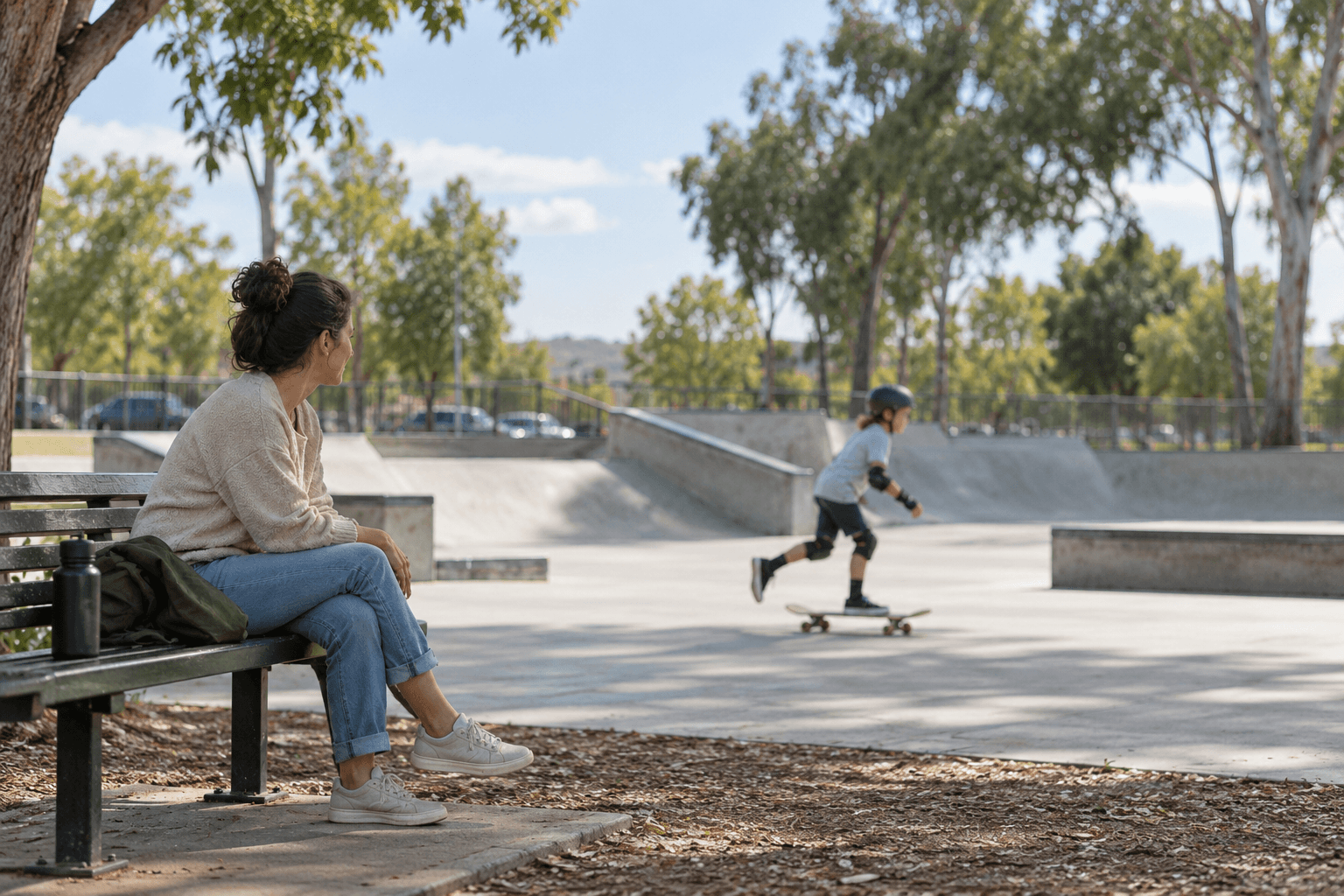
Your kid comes home and says they want to learn to skateboard. Your first thought isn’t “great, what a fun hobby.” It’s broken arms. Cracked skulls. Emergency rooms. YouTube clips of people eating concrete.
I’m not going to tell you that reaction is wrong. It’s not. You’re a parent watching your kid ask to do something that looks dangerous, and your brain does exactly what it’s supposed to do—it says be careful.
But I will tell you this: after teaching over 300 kids to skateboard, the worst injury I’ve seen during a lesson is a scraped knee. And the data backs that up in ways that might surprise you.
How dangerous is skateboarding for kids?
Less dangerous than most parents assume. The American Academy of Pediatrics reports roughly 8.9 skateboarding injuries per 1,000 participants per year—lower than basketball (12 per 1,000) and significantly lower than football (over 20 per 1,000). With proper gear and supervision, the risk drops even further.
Skateboarding looks more dangerous than it is. Part of that is the culture—skate videos are highlights of the gnarliest tricks, the biggest slams, the worst falls. Nobody posts a clip of a kid cruising safely around a parking lot. So the mental image most parents have is wildly skewed.
Here’s what the actual numbers show. The American Academy of Pediatrics puts the skateboarding injury rate at about 8.9 per 1,000 participants per year. Basketball is around 12. Football is above 20. Soccer is in the 7–12 range depending on the study. Even cycling—the thing most parents let their kids do without a second thought—has a higher rate of emergency room visits for children than skateboarding does.
Nobody panics when their kid signs up for basketball. But a skateboard? Suddenly it’s extreme.
I wrote a full breakdown of the safety data in Is Skateboarding Safe for Kids? if you want the detailed stats. But the headline is this: per hour of participation, skateboarding is safer than most of the sports parents sign their kids up for every fall.
What makes skateboarding dangerous for beginners?
The biggest risk factor is skating unsupervised without protective gear. According to Safe Kids Worldwide, the majority of skateboarding injuries treated in emergency rooms involve riders who were not wearing helmets. Structured lessons with certified helmets, proper pads, and an instructor controlling progression dramatically reduce injury rates compared to unsupervised skating.
Here’s the thing most injury stats don’t tell you: the vast majority of skateboarding injuries happen to unsupervised kids skating without helmets, often attempting things they’re not ready for. A 12-year-old who watched a YouTube video and tries to drop into a six-foot ramp with no gear on is going to get hurt. That’s not a skateboarding problem. That’s a supervision problem.
The difference between supervised instruction and unsupervised skating is night and day. In a structured lesson, here’s what happens: the kid wears a helmet. Always, no exceptions. They learn how to fall before they learn how to ride. They start on flat ground. They don’t move to the next skill until they’ve got the current one down. There’s an adult right there whose entire job is watching them and keeping them safe.
That’s not the same activity as a kid who grabs a board and heads to the park alone. Saying “skateboarding is dangerous” without that distinction is like saying “swimming is dangerous” without distinguishing between swim lessons and jumping into a lake with no lifeguard.
Want to see how it works?
Book a single lesson and watch the whole thing. If you're not comfortable, no pressure to continue.
What happens in a kids’ skateboard lesson?
Kids learn to fall safely before they learn to ride. A typical first lesson covers bail technique, stance, balance, pushing, and stopping—all on flat ground with a helmet and pads on. The CPSC recommends that all beginner skateboarders wear helmets, wrist guards, and knee and elbow pads, and that’s standard gear for every lesson I teach.
I think a lot of the fear comes from not knowing what a skateboard lesson is. Parents picture a kid flying off ramps. The reality is much more boring than that—in a good way.
First lesson, we spend time on the ground. Literally. I teach every kid how to bail safely before we do anything else. How to fall forward and roll. How to step off the board. How to absorb impact with their pads instead of their wrists. Once they know how to fall, the stakes of falling drop dramatically.
Then it’s stance and balance on flat ground. Pushing. Stopping. Turning. The stuff that looks unexciting but builds the foundation for everything else. I wrote about what a first lesson covers in more detail. I don’t let a kid near a ramp until they can ride, turn, and stop confidently on flat ground—and until they want to. Some kids skate flat ground for weeks and are perfectly happy doing it.
Helmets are required every single session. No exceptions, no negotiation. I provide loaner gear for kids who don’t have their own yet, so there’s never a reason to skip it.
What are parents really afraid of with skateboarding?
Broken bones, head injuries, and embarrassment are the three fears I hear most. The data helps here: the CPSC reports that wrist fractures are the most common skateboarding injury requiring medical attention, and wrist guards significantly reduce that risk. A properly fitted CPSC-certified helmet reduces serious head injury risk by up to 85%. In supervised lessons with gear, these injuries are genuinely rare.
“What about broken bones?”
It can happen. It can also happen playing tag at recess, jumping on a trampoline, or riding a bike. The most common fracture in skateboarding is a wrist fracture, and wrist guards reduce that risk significantly. In supervised lessons where kids wear proper gear and progress at their own pace, fractures are genuinely rare. I’ve never had one in a lesson.
“What about head injuries?”
This is the one parents worry about most, and I take it seriously. That’s why helmets are non-negotiable. A properly fitted, certified helmet reduces the risk of a serious head injury by up to 85%. The head injuries that make the news almost always involve someone skating without a helmet. With one on, skateboarding has a lower concussion rate than football, hockey, soccer, and basketball.
“What if they get embarrassed and give up?”
Private and small-group lessons take care of this. Your kid isn’t performing in front of a team or a crowd. It’s just them and the instructor. They can fall, get frustrated, take a break, and try again without anyone watching. Most kids who are nervous at the start of a lesson are asking when the next one is before it’s over.
Should I let my kid try skateboarding?
If your kid is asking, the answer is probably yes—with the right setup. Research from the AAP shows that supervised, age-appropriate risk-taking in physical activity helps children build resilience, confidence, and better risk-assessment skills. A structured lesson with proper gear gives your kid those benefits while keeping actual danger low.
I want to flip this around for a second. Because there’s a risk on the other side of this decision, and it’s one most parents don’t think about.
Kids need to do things that feel a little scary. They need to fall and get back up. They need to attempt something hard, fail at it ten times, and then nail it on the eleventh. That process —choosing to do something difficult, managing the risk, dealing with the outcome—is how kids build real confidence. Not the participation-trophy kind. The kind that holds up under pressure.
Skateboarding is one of the best vehicles for that. It’s physical, it’s real, and the feedback is immediate. You either landed it or you didn’t. There’s no participation award. And that kind of resilience transfers to everything else in a kid’s life—school, friendships, hard conversations, new challenges.
When you say no to something your kid is genuinely excited about because you’re scared, you’re not just saying no to skateboarding. You’re telling them that the scary thing is too much for them. Kids hear that. And over time, they start to believe it.
I’m not saying every kid should skateboard. I’m saying that if your kid is asking to try, the answer probably shouldn’t be no just because you’re nervous. There are ways to let them try that keep the risk low and the reward high.
What would a skateboard instructor tell a nervous parent?
Book one lesson and watch the whole thing. Most parents who are nervous beforehand feel completely different after seeing how structured and controlled a lesson actually is. I’ve taught over 300 kids, and the worst injury I’ve seen during a lesson is a scraped knee. Your fear is valid—but it shouldn’t be the only data point you use to decide.
If a friend came to me with this—“my kid wants to skateboard and I’m scared”—here’s what I’d say: book one lesson. Just one. Come watch the whole thing. See the gear, see the approach, see your kid’s face when they stand on that board and push for the first time. Then decide.
You can also start with some reading. The gear guide covers exactly what your kid needs. The safety breakdown has the full data. And the kids’ lesson page shows exactly how I structure sessions for new riders.
Your fear doesn’t make you a bad parent. It makes you a parent. But don’t let it be the only voice in the room.
Frequently Asked Questions
What gear does my kid need for skateboarding?+
At minimum, a properly fitted helmet certified to CPSC or ASTM standards. For beginners, I also recommend knee pads, elbow pads, and wrist guards. I require helmets for all kids’ lessons and provide loaner gear when needed. The full gear guide covers specific product recommendations.
What’s the most common skateboarding injury for kids?+
Scrapes and bruises, by a wide margin. The most common injury requiring medical attention is a wrist fracture, which is why wrist guards are recommended. Serious injuries are rare in supervised settings with proper gear — they mostly happen when kids skate unsupervised without helmets.
Is skateboarding more dangerous than other youth sports?+
No. Per hour of participation, football, basketball, soccer, and cycling all have higher injury rates. The AAP reports about 8.9 skateboarding injuries per 1,000 participants annually, compared to 12 for basketball and over 20 for football.
At what age is it safe for kids to start skateboarding?+
Most kids can start structured lessons around age 5-6. Kids as young as 3-4 can get comfortable on a board with close supervision. The key factor is whether they have enough balance and attention span to follow safety instructions.
What if my kid isn’t comfortable with ramps?+
That’s completely fine. Lessons start on flat ground — parking lots, tennis courts, smooth paths. Most kids spend their first several sessions without going near a ramp. There’s no timeline and no pressure. Some kids skate flat ground for months and love every minute of it.
How do I know if lessons are supervised enough to be safe?+
Look for an instructor who requires helmets with no exceptions, teaches falling technique before tricks, starts on flat ground, and progresses based on what the kid can do. Private or small-group lessons with a dedicated instructor are significantly safer than unsupervised park sessions.
One lesson. See for yourself.
Private skateboard lessons for kids in NYC and Westchester. Helmets required, flat ground first, your kid’s pace. You’re welcome to stay and watch the whole thing.