September 14, 2026
Skateboarding for toddlers and 3-year-olds: when can kids start?
What I’ve learned teaching the youngest kids to stand on a board for the first time.
I get this question a lot from parents of very young kids: “My daughter is 3 and she keeps trying to stand on her brother’s board. Is she too young?” The honest answer is that some 3-year-olds are ready for an introduction, and some aren’t. It has less to do with age and more to do with the individual kid.
I’ve been teaching skateboarding for over 20 years, and I work with kids as young as 3. But a lesson for a toddler looks nothing like a lesson for a 7-year-old. The expectations are different, the approach is different, and the timeline is different. Here is what parents should know.
How do you know if your toddler is ready for skateboarding?
Readiness has more to do with the individual child than a number on a birthday cake. If your toddler can stand on one foot for a second or two, follow simple directions like “hold my hand,” and actually wants to try the board on their own—those are the signs I look for before we start.
I don’t go by age alone. When a parent asks me about their 3-year-old, I ask a few questions first:
- Can they stand on one foot, even for a second or two? They don’t need to be great at it. Any ability to balance independently is a good sign.
- Do they follow simple directions? “Stand here” and “hold my hand” are about as complex as it gets in a first lesson for a toddler.
- Are they the one who wants to do it? A 3-year-old who grabs the board on their own is different from one who was handed it by a parent. Genuine curiosity goes a long way at this age.
- Can they handle being told “try again”? They don’t need to be fearless. But if they fall off the board and want to get back on, that tells me something.
If you’re not sure, that’s fine. Book a single session and we’ll find out together. I can tell within a few minutes whether a kid is ready to try or whether giving it another six months would be better. No pressure either way.
What does a skateboard lesson look like for a 3 year old?
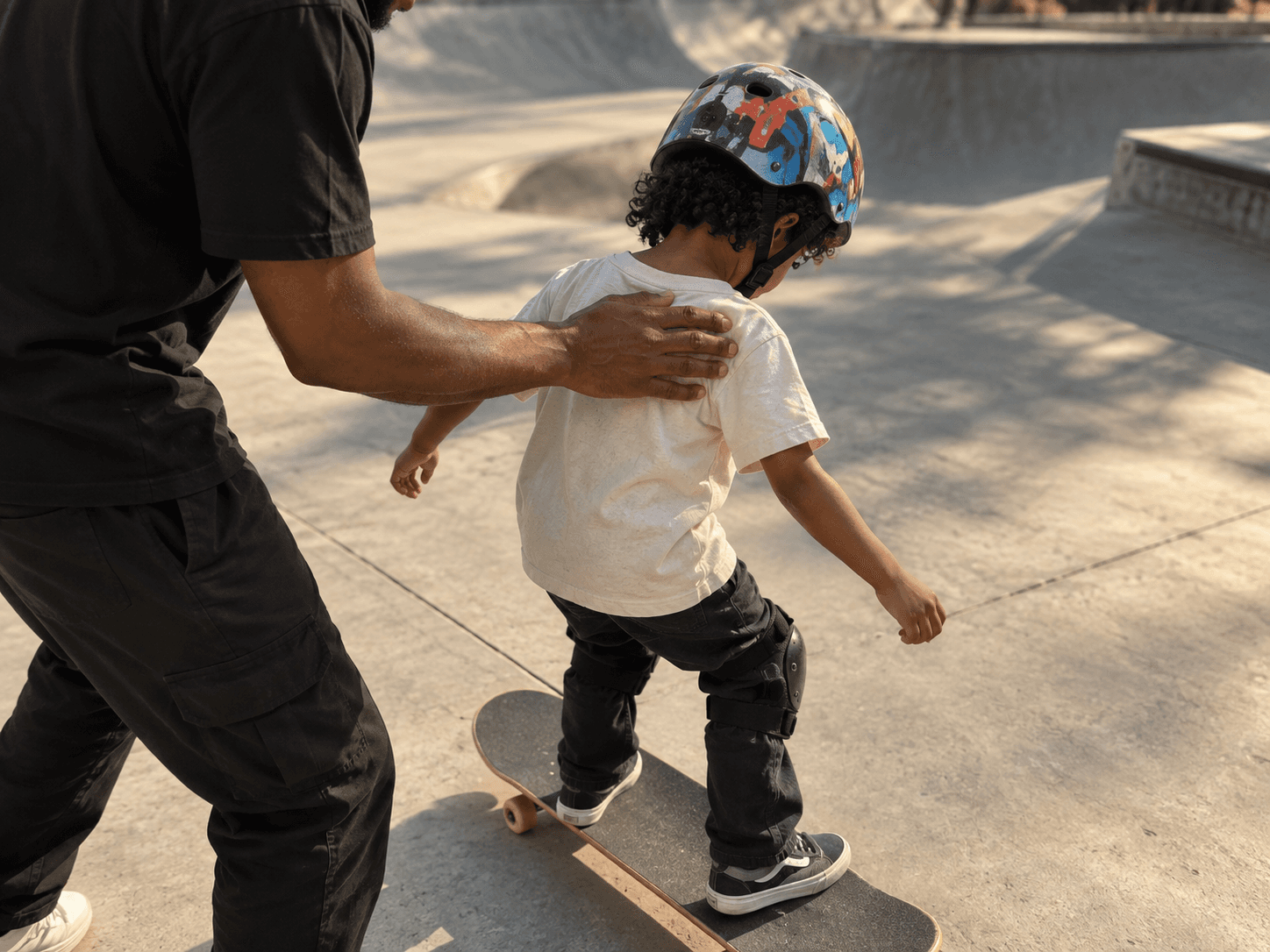
It looks like play—because that is exactly what it is. We start on grass so the board stays still, then move to sitting, standing with support, and eventually a short roll on flat pavement. The goal is exposure and fun, not tricks. If your child walks away wanting to do it again, that is a successful first lesson.
A toddler lesson is not a scaled-down version of a regular lesson. It is its own thing. We start on grass or carpet so the board doesn’t roll. The first step is just sitting on the board. Sounds simple, but for a 3-year-old, this is a whole new experience. They feel the shape of the deck, the way it tips side to side, and they start getting comfortable.
From there, we stand up together. I hold their hands or they hold onto my arms. We rock the board left and right, forward and back. We play balance games—I might ask them to wave one hand in the air while standing on the board, or we count to five before stepping off. Everything is a game at this age.
Once they seem comfortable standing, we move to flat pavement and I roll them a few feet while holding their hands. That first little roll usually gets a big reaction. Some kids light up. Some get nervous and want to go back to grass. Both are fine. We go at their pace.
Nobody is learning kickflips at age 3. The goal is exposure. I want them to walk away thinking the board is fun, not scary. If they ask to do it again, that is a successful first lesson.
Can toddlers focus long enough for a skateboard lesson?
Most toddlers stay engaged for 15 to 30 minutes, and that is plenty. Research on early childhood attention suggests 3-year-olds can typically sustain focus for about 6 to 15 minutes on a single task. Switching activities every few minutes—standing, sitting, a balance game, a short roll—keeps the session moving within that natural range.
A typical lesson for an older kid or adult runs about an hour. For a 3-year-old, 15 to 30 minutes is usually the right window. Some days a toddler is locked in for 25 minutes. Other days they are done after 10. I do not fight it. If the kid is checked out, we stop. Pushing a toddler past their limit does not teach them skateboarding. It teaches them that skateboarding is something they get forced to do.
I structure sessions for the youngest kids differently than I would for a 6 or 7-year-old. We switch activities every few minutes. Standing, then sitting, then a balance game, then a short roll. Keeping it varied keeps them engaged. I also take cues from the kid. If they want to spend the whole time sitting on the board and pushing it around with their hands, we do that. They are still building a relationship with the board.
Thinking about a lesson for your little one?
Book a private session for your toddler. Leon works with kids as young as 3 in NYC and Westchester. Boards, helmets, and pads provided.
What skateboard gear do toddlers need?
A micro or mini deck (6.5 to 7.0 inches wide), a CPSC-certified helmet that sits level and does not wobble, and knee pads plus wrist guards at minimum. Avoid the plastic toy boards from big box stores—they roll unpredictably and the grip wears off fast. I bring all of this to every session, so you do not need to buy anything before the first lesson.
Gear matters more for younger kids than anyone. A toddler on a full-size skateboard is going to struggle. The board is too heavy, too wide, and too fast. Here is what works:
- Board:A micro or mini deck, 6.5 to 7.0 inches wide. Lighter, narrower, and easier for small feet to control. Avoid the plastic toy boards from big box stores—they roll unpredictably and the grip wears off fast.
- Helmet: A CPSC-certified helmet that fits. It should sit level on the head, not tilted back. If it wobbles, it is too big. Toddler-specific sizing is available from most skate brands.
- Pads: Knee pads and wrist guards at minimum. Elbow pads too if you want the full setup. At this age, falling is part of the process and pads make it a non-event.
You do not need to buy all of this before the first lesson. I bring boards, helmets, and pads to every session. If your kid takes to it and you want to buy their own setup, I can help you pick the right size. For a deeper breakdown of gear, check out my protective gear guide.
Should parents stay during toddler skateboard lessons?
Yes—for kids this young, I always encourage parents to stay close and be part of it. Having mom or dad nearby helps the child feel safe, and it gives you a chance to see what we are working on so you can practice at home. Some toddlers want a parent right next to them. Others warm up and do fine a few feet away. Either way, the lesson works best as a team effort.
For toddlers, I always encourage parents to stay close and be part of the lesson. With older kids, I sometimes ask parents to step back a bit so the kid can focus. With a 3-year-old, it is the opposite. Having mom or dad right there helps the kid feel safe, and it gives the parent a chance to see what we are working on so they can practice at home.
Sometimes I will have a parent hold the child’s hands while I adjust their foot position. Other times the parent stands a few feet away as a “finish line” the kid rolls toward. It depends on the kid’s comfort level. The point is that you do not just drop off your toddler and come back in an hour. At this age, the lesson works best as a team effort.
How do you keep toddlers safe on a skateboard?
Flat ground only, full pads and helmet required, and I stay within arm’s reach the entire time. At toddler speeds—barely rolling or stepping off from a standstill—falls are not a big deal. The American Academy of Pediatrics recommends helmets and protective gear for all young skateboarders, and I enforce that with no exceptions.
Safety is the number one concern for parents of toddlers, and I take it seriously. Every lesson for a 3-year-old stays on flat ground. No hills, no ramps, no skatepark features. I stay within arm’s reach the entire time. Full pads and helmet are required, no exceptions.
At this age, we are moving slowly enough that falls are not a big deal. A toddler who steps off the board is stepping off from a standstill or barely moving. With pads on, they usually do not even notice. I wrote more about this topic in my post on whether skateboarding is safe for kids.
When is a toddler too young for skateboarding?
If a 3-year-old shows no interest in the board, is not comfortable standing on it after a few tries, or gets upset quickly, waiting six months to a year is the right call. Kids develop at different speeds, and a child who is not ready at 3 might be completely ready at 4. There is no downside to giving it more time.
Not every toddler is ready, and that is perfectly fine. If a 3-year-old has no interest in the board, is not comfortable standing on it after a few tries, or gets upset quickly, there is nothing wrong with waiting six months or a year and trying again. Kids develop at different speeds. A child who is not ready at 3 might be completely ready at 4.
The best time to start is when your kid is genuinely curious. If they keep climbing on the board, keep asking about it, or light up when they see someone skateboarding—that is your signal. All you need is a helmet and some patience.
For a broader look at readiness by age group, I covered that in my post on what age kids can start skateboarding.
Frequently asked questions
Ready to get your little one on a board?
Private lessons for toddlers and young kids in NYC and Westchester. I bring the boards, helmets, and pads. $120/hr private, $80/person group.
Book a Lesson